Agriculture
Agriculture and rural livelihoods
Farm-input assistance and rural infrastructure were recurring themes in the administration’s support for agricultural communities.
Agriculture has been a recurring theme in Abdulaziz Yari’s public-service work, from the rural-development programme of his governorship to later farm-input assistance during his Senate service. The needs of farming households connect several areas of public activity: access to inputs, water, transport and the markets through which produce reaches buyers.
During the 2011–2019 governorship period, fertiliser and other agricultural inputs formed part of the administration’s support for rural communities. Roads and basic services were pursued alongside that support. In July 2025, a separate Senator-supported fertiliser intervention focused on the cost faced by smallholder farmers preparing for the wet farming season. These are distinct periods and arrangements within a continuing concern with agricultural livelihoods.
Agriculture within rural development
A farm does not operate in isolation from the community around it. Inputs have to reach the farmer, produce has to reach a buyer and household members need access to the same public services as other residents. Agricultural support is therefore connected to the wider condition of rural infrastructure.
The governorship programme addressed farming within that broader setting. Fertiliser assistance concerned an input used in production, while roads concerned access and movement. Water infrastructure served its own community purposes and formed part of the wider rural-service environment.
These different forms of investment should be understood together without treating them as interchangeable. A road does not replace an input, and an input distribution does not remove the need for access to markets. Their relationship is practical: farming households encounter several demands during the same season, even when public institutions manage them separately.
Timing and the farming season
Timing is central to farm-input support. A commodity available when a farmer needs it serves a different purpose from one delivered after the relevant stage of the season. Distribution arrangements must therefore relate to the intended agricultural period, as well as to the quantity being made available.
The July 2025 intervention was organised for that year’s wet farming season. Its public purpose was to reduce the price paid by smallholder farmers for fertiliser. The programme concerned a specific input and a defined period, rather than a permanent commitment that every farmer could obtain the same support at any time.
Attaching the season to the programme helps readers understand its role. Agriculture follows a sequence of decisions and activities, and support becomes useful through its place in that sequence. The delivery process matters alongside the financial contribution.
The 2025 fertiliser intervention
Preparations for the 2025 programme included inspection of fertiliser at ASAD Fertiliser Blending Company in Bungudu. The arrangement set a subsidised price of ₦20,000 per bag for participating farmers, with a committee responsible for distribution. Smallholders were the principal intended beneficiaries.
The planned delivery channel extended to the headquarters of Zamfara’s 14 local government areas, with transport of the commodity to those locations provided without a separate delivery charge to farmers. This addressed the geography of access as well as the price of the fertiliser itself.
The intervention was statewide. That scope is different from Senator Yari’s elected mandate in Zamfara West, and both descriptions should remain clear. A programme can assist residents beyond an elected district while retaining its own purpose, arrangements and measurement period.
Making access practical
The price of an input is only one part of the cost of obtaining it. Farmers must also consider where to collect it, the distance involved and the effort required to move it onward. Organising distribution through local government headquarters was intended to make the commodity more accessible across the state.
That approach gives the programme a defined delivery structure. It connects a supply point and distribution committee with collection locations closer to intended participants. The details matter because an intervention is experienced through the steps a farmer must actually take to receive support.
The account concerns the arrangements for the 2025 season. It does not assign a completed beneficiary total to the programme or assume that every consignment produced an identical outcome. Individual farm circumstances and the wider conditions of the season remain relevant to how an input is used.
Smallholders and household decisions
Smallholder farming is closely connected to household planning. Decisions about inputs take place alongside other needs, including food, schooling, transport and healthcare. A reduction in the price of one agricultural input can affect that set of choices, even though it does not remove every cost involved in farming.
This is the practical importance of targeted input assistance. It addresses a recognisable expense within production, allowing the programme’s purpose to be understood without making promises about harvest size or future income. Those outcomes depend on several conditions beyond the provision of fertiliser.
The distinction also respects the work of farmers themselves. Public support is one contribution within a farming activity that involves knowledge, labour, decisions and risk. The farmer’s role remains central, and a programme should not claim every later result as the automatic product of an intervention.
Roads, markets and the movement of produce
Transport connects farm activity with local and wider markets. Inputs travel towards farming communities, while produce moves towards buyers, traders or processors. The condition of those connections can influence the effort involved in both journeys.
Roads were part of Yari’s governorship infrastructure programme, including routes connecting communities beyond the state capital. Their relationship with agriculture lies in that movement of people and goods. A usable route can support access, while the wider market conditions still determine how trade takes place.
The road programme and later fertiliser assistance belong to different periods, but they illustrate the range of issues involved in agricultural livelihoods. One concerns the network around production; the other concerns a particular input within it. Both are more useful when understood through the daily decisions of farming households.
Water and the wider agricultural setting
Water is another important part of the environment in which farming takes place. In Zamfara, agricultural activity exists alongside major irrigation infrastructure and community water needs. Different schemes have different purposes, funding bodies and responsibilities, which must remain distinct in any account of public work.
The federal Bakolori rehabilitation programme launched in 2017 was a Federal Ministry of Water Resources undertaking within the World Bank-assisted TRIMING programme. Its location in Zamfara did not make it a personally owned or exclusively state-funded Yari project. It forms part of the wider agricultural setting of the governorship years.
Recognising those institutional boundaries makes the rural-development story clearer. State programmes, federal schemes and Senator-supported interventions can all affect the same communities while remaining separate undertakings. Their respective roles should be understood on their own terms.
Following agricultural support over time
Agricultural assistance is most useful to the public when each intervention has a date, a purpose and a clear description of its intended participants. That allows farmers and other residents to distinguish a historical programme from an active distribution notice and to understand the arrangements attached to a particular season.
The 2025 wet-season programme is recorded separately from food assistance during Ramadan and from the governorship’s agricultural work. Food support addresses immediate household needs; fertiliser support concerns production. Combining their figures would obscure the different purposes and people involved.
Agriculture’s place in the public-service record is therefore both historical and practical. It follows the connection between rural infrastructure, input access and household livelihoods, while keeping individual programmes tied to their own periods and delivery arrangements. The centre of that story remains the farming community and the conditions in which its work takes place.
Farmers and traders in their own words
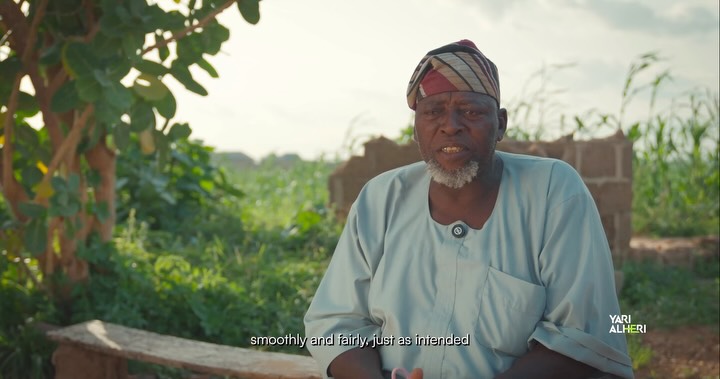
The Talata Mafara farming film introduces a farmer who explains how access to fertiliser affects the land he cultivates and the household that depends on it. His account follows the work before a harvest: obtaining inputs, committing labour and preparing for the season. It adds an individual perspective to the programme arrangements.
A companion market feature follows a representative of traders who move produce to destinations beyond Zamfara. He describes working-capital support and the connections between local buying and wider markets. The two films show different parts of the agricultural economy while preserving each participant’s own experience.
- Period
- 2011–2019
- Office
- Governor of Zamfara State